ECCU – Energy Carbon Capture & Utilisation
Sustainability and emission-free operations are at the core of Westenergy’s strategy, and are also key priorities for our owners, business partners, and the entire Vaasa region. Westenergy’s goal is to achieve carbon-neutral energy production by the early 2030s, and we are actively advancing this goal through our carbon capture and utilisation project, ECCU.
The objective of the ECCU project is to build a state-of-the-art carbon capture plant next to Westenergy’s waste-to-energy plant.
The objective of the ECCU project is to build a state-of-the-art carbon dioxide capture plant next to Westenergy’s waste-to-energy plant. Once completed, the plant will substantially reduce carbon dioxide emissions from the flue gases of Westenergy’s waste-to-energy plant. After commissioning, the new unit will be capable of capturing up to 95 per cent of the carbon dioxide in flue gases.
The recovered and liquefied carbon dioxide is intended for delivery to Koppö Energia’s future plant in Kristiinankaupunki for the production of synthetic fuels. This amount corresponds to an estimated 1.18 billion kilometres driven by fossil fuel-powered cars in Finland, or approximately 431,000 return flights from Helsinki to Brussels. Overall, the ECCU project supports industrial development in the Vaasa region, creates new investment opportunities, and promotes the goals of a sustainable circular economy in Finland.
The project supports industrial development in the Vaasa region, creates new investment opportunities, and promotes the goals of a sustainable circular economy in Finland.
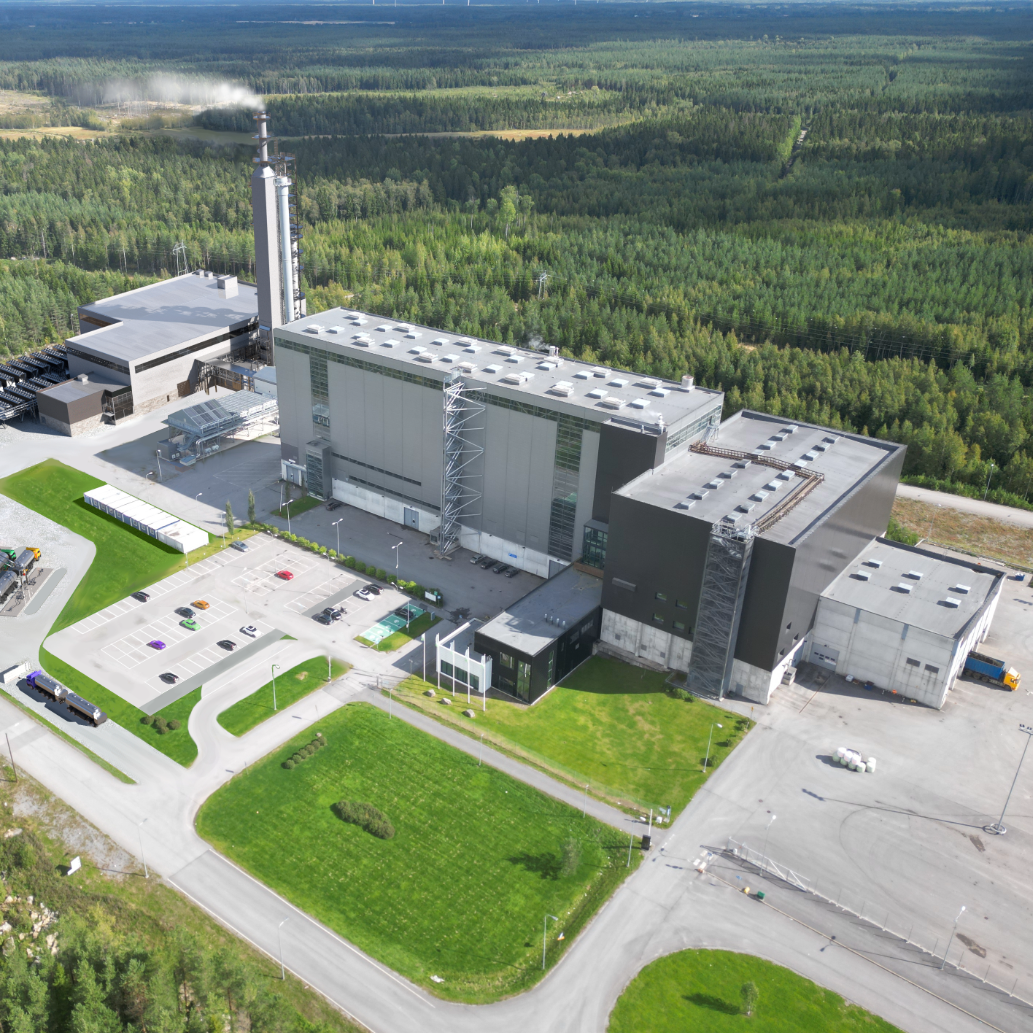
Visualisation of the carbon recovery plant
The roots of the carbon dioxide capture and utilisation project go back a long way, but on this scale, the project has gained momentum since 2023, when we signed an agreement with CPC Finland Oy, Prime Capital AG and their joint venture Koppö Energia Oy to develop, construct, and operate a carbon dioxide recovery and liquefaction plant. During the same year, the project received an energy investment subsidy of 20 million euros from the the Ministry of Economic Affairs and Employment of Finland.
To support the dedicated project company, Eccu Oy in the implementation and management of the plant Ramboll Denmark A/S was selected as the Owner’s Engineer. In the same year, a contract was signed with Andritz AG for the front-end engineering design (FEED) of the recovery process. Together with our partners, the project progressed systematically into the (FEED) phase, ensuring the feasibility of technical, financial, and operational solutions before the final investment decision.
Over the past year, we have worked diligently on the FEED phase. This planning stage has been crucial in helping us define the plant’s technical concept and structure, plan the details of the implementation phase, and prepare the key permits necessary for the project to move forward. The front-end engineering design of the recovery process was successfully completed during 2025, and the municipality of Mustasaari granted the plant a construction permit in December 2025.
Before any final investment decision leading to construction can be made, certain regulatory matters and key agreements still need to be resolved, which we are actively working on. The carbon capture plant is planned to be commissioned in 2028, and once completed, it will be one of the first full-scale carbon capture plants in the waste-to-energy sector.
The carbon capture plant is planned to be commissioned in 2028. Once completed, it will be one of the first full-scale carbon capture plant in the waste-to-energy sector.
In the future, in addition to synthetic fuel production, carbon dioxide is also intended to be used in the manufacture of other products that permanently bind carbon. Over the past year, Westenergy has actively explored potential end users of carbon dioxide across different industries, as well as the commercial feasibility of using recycled carbon dioxide in various products. In addition to the production of synthetic fuels, carbon dioxide can be utilised, for example, in the production of mineral products for the construction industry as well as chemical industry products such as plastics.